Strategic Pitfalls: 7 Branding Errors Eradicating FMCG Sales

In the Fast-Moving Consumer Goods (FMCG) sector, product failure rarely stems from poor quality. More often, products fail simply because they are not selected.
This critical decision does not occur during a high-level marketing presentation or within a boardroom. It happens in a fraction of a second on a chaotic retail shelf, where consumers rely on rapid, subconscious scanning rather than deliberate evaluation. At this exact moment, your branding either secures the sale or silently drives revenue to your competitors.
Effective branding is not about aesthetic trends; it is about facilitating decision-making under pressure. Below are the seven most critical branding missteps FMCG companies make, and how to rectify them.
Designing for Executive Approval Rather Than Consumer Selection
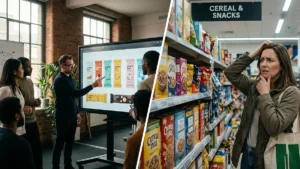
Too often, packaging is engineered to satisfy internal stakeholders. Founders, executive teams, and creative agencies frequently fall in love with polished mockups that look “premium” in a boardroom. However, consumers do not care about internal consensus. They care about a single question: “Why should I buy this?” If a design is optimized for a slide deck rather than a competitive retail environment, it will fail.
The Solution: Prioritize shelf impact over presentation aesthetics. If a product fails to capture attention within two seconds, it effectively does not exist to the shopper.
Conflating Aesthetics with Strategic Communication
A package can be visually stunning and still fail to generate sales. Beauty does not guarantee clarity. When design choices are dictated by fleeting trends, personal preferences, or abstract mood boards, they lose their connection to measurable business outcomes.
The Solution: Every visual element must serve a strategic purpose. Ask yourself: What specific message or value proposition does this graphic asset communicate to a distracted consumer instantaneously?
Evaluating Designs in Isolation
Most packaging is reviewed in a sterile, perfect environment—on large, backlit monitors with clean backgrounds. Real-world retail shelves are the exact opposite: they are crowded, visually chaotic, and highly competitive. A design that looks powerful on a screen often becomes invisible when surrounded by dozens of rival products.
The Solution: Always evaluate new packaging concepts within a simulated, high-density shelf environment alongside direct competitors.
Ambiguous or Weak Value Positioning
If your packaging fails to immediately communicate what the product is, who it caters to, and why it is superior to the alternative, consumers will not waste time trying to figure it out. In a fast-paced retail environment, clarity invariably outperforms abstract creativity.
The Solution: Ensure the packaging instantly answers the consumer’s ultimate question: “Why should I choose this over the established brand next to it?”
Overloading the Visual Hierarchy
In an attempt to justify value, brands often clutter their packaging with a laundry list of features, benefits, claims, and certifications. This approach inevitably leads to cognitive overload and decision paralysis. Because consumers scan rather than read, highlighting everything means nothing stands out.
The Solution: Practice ruthless prioritization. One singular, powerful message will consistently outperform five competing claims.
Treating Brand Identity as a Finite Project
Many companies treat branding as a one-off task on a checklist (e.g., “we finished the logo and the box”). In reality, branding is an active, continuous ecosystem. When your packaging, digital presence, and corporate communication lack cohesion, the brand feels fragmented, rapidly eroding consumer trust.
The Solution: Shift your perspective from viewing branding as a static deliverable to managing it as an integrated visual and communicative system.
Neglecting Empirical Real-World Validation
This is perhaps the most capital-intensive mistake an FMCG brand can make. Final designs are frequently greenlit based on subjective opinions and internal feedback rather than objective data. Launching a product without testing it in true market conditions is merely guesswork.
The Solution: Validate your designs through consumer testing in realistic, comparative shopping environments before investing in large-scale print runs and distribution.
The Core Takeaway
Ultimately, FMCG branding is not a form of artistic expression; it is a tool of behavioral economics. Your packaging is an instrument designed to command attention, build trust, and drive consumer choice.
If your current sales figures are not meeting forecasts, audit your presence against these four pillars: Visibility, Clarity, Differentiation, and Credibility. If your product lacks any of these, your branding is actively restricting your growth.
Frequently Asked Questions (FAQs)
Why do good FMCG products still fail in the market?
Even high-quality FMCG products can fail because they are not chosen at the point of sale. Consumers make split-second decisions on crowded shelves, relying on quick visual cues rather than detailed evaluation. If branding does not instantly capture attention and communicate value, the product gets overlooked.
Is attractive packaging enough to drive sales?
No. While aesthetics can draw attention, they do not guarantee conversions. Effective packaging must communicate a clear value proposition immediately. Design should not just look good—it must answer the consumer’s question: “Why should I buy this?”
Why is testing packaging in real retail environments important?
Designs often look effective in isolation but fail in crowded retail settings. Real shelves are visually cluttered, and competition is intense. Testing packaging in simulated or actual retail environments ensures it stands out and performs under real-world conditions.
What is the biggest mistake brands make in packaging design?
One of the most common mistakes is overloading packaging with too many messages—features, claims, and certifications. This creates confusion and reduces impact. Strong packaging focuses on one clear, dominant message that consumers can grasp instantly.
How should companies approach branding in the FMCG sector?
Branding should be treated as an ongoing system, not a one-time project. Consistency across packaging, digital presence, and communication builds trust and recognition. Continuous testing and refinement based on real consumer behavior are essential for sustained growth.